- Commercial Greenhouse
- Film Greenhouse
- PC Greenhouse
- Glass Greenhouse
- Tunnel Greenhouse
- Scientific Research Greenhouse
- Vegetable Greenhouse
- Flower Greenhouse
- Multi-span Greenhouse
- Sawtooth Greenhouse
- Greenhouse Equipments
- Greenhouse Accessories
- Hot Dip Galvanized Pipe
- Irrigation System
- Hydroponics System
- Planting Tools
- Planting technology
Tel: +86 191 5068 3942
Fax:
Mobile: +86 191 5068 3942
Contact: Alina
E-mail: sales@cngreenhouses.com
SKYPE:


When to Choose a Glass Greenhouse for Agriculture
Not every crop justifies glass. See when a glass greenhouse for agriculture pays off - nursery, research, high-value crops - and when it does not.
.
TEL:+86 191 5068 3942
- Features


Basic Information:
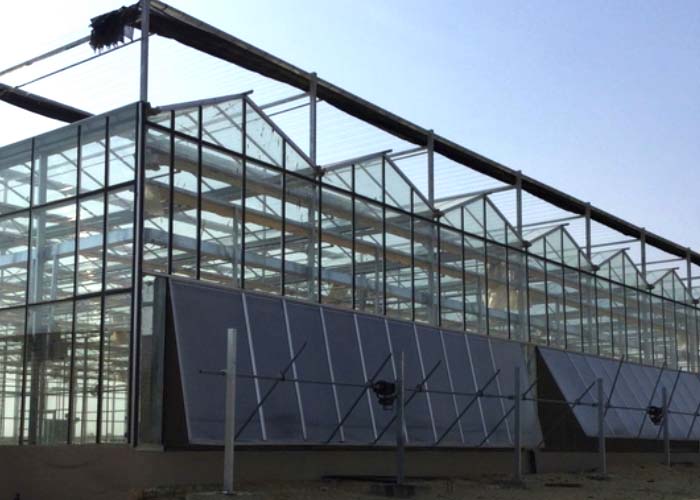
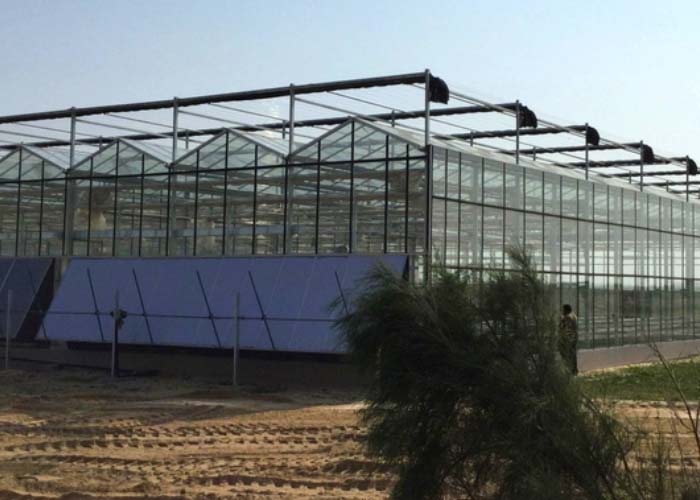
Size: 15m*30m. Cover Material: Glass. Layer: Single. Type: Glass Greenhouse.
Feature: Small Scale. Area: 450 Square Meter.
Wind Load: 0.35kn/M2. Snow Load: 0.35kn/M2.
Export Markets: Global.
Application: Scientific research, High-end seed nursery, Hydroponics, etc.
When a Glass Greenhouse Pays Off in Agriculture
Glass is not chosen because it looks good, but because the crop under it turns light into money faster than a film or PC cover would. A glass house transmits above 90 percent of the light that reaches it, so the question is not whether glass is a good cover. It is whether your crop, your site and your working season can carry it.
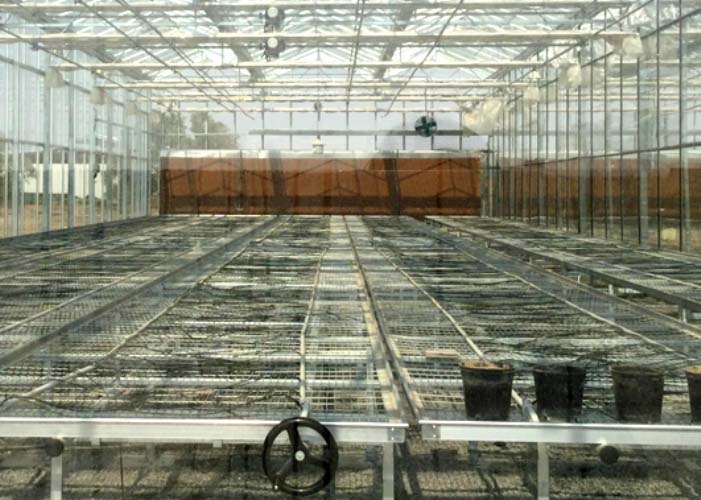
High-end seed nursery. Even seedlings need even light. Glass gives an unobstructed, uniform field of light over the whole floor, and a multi-span roof spreads it without the shadow bands a hoop frame throws. Propagation is where the money is made first, so this is the case that most often justifies the frame. A nursery block is usually laid out with rolling seedling benches so the floor serves trays rather than soil.
Scientific research. A trial compartment has to be an environment you can describe and repeat. Glass is inert, it can be washed down between trials, and its light level is readable. The 15 m by 30 m footprint can be divided into compartments, which is why the same frame serves research greenhouses as well as production.
Hydroponics and high-value crops. Where value per square metre is high, the extra light pays the difference back: leafy greens on a gutter system, herbs, out-of-season cut flowers and grafted vegetable plants. The glass greenhouse range covers this logic from a single house up to a full multi-span block.
Display, teaching and agritourism. Visitors read a glass building as a greenhouse immediately, so where the crop is shown as much as sold, the appearance of the house is part of the product.
Difficult ground. A glass house is a simple and effective solution for varied and complex topographic conditions: the structure is carried on its own frame and foundation, not on the shape of the land.
Where Glass Is Not Worth It
The same figures work in reverse. Glass is the most expensive of the common covers to buy, to install and to keep clean, and it is the weakest at holding heat. It is the wrong answer in four situations.
Low-value bulk crops. Field vegetables that open ground can carry do not need 90 percent light under a steel frame. The cover adds cost the crop cannot repay.
A short working season. If the house is only used for a few weeks each year, a film cover does the same job at a lower first cost and is simple to replace. Glass pays back over years of use, not over one season.
Cold sites where heating, not light, is the cost. Single-layer glass loses heat quickly. Where the winter heating bill is the deciding number, a double-layer film or a PC sheet house holds warmth better. The covers are compared on those terms in film, glass and PC sheet compared.
No labour for glass care. Glass only stays at 90 percent transmission while the panes are clean. A dusty or algae-streaked roof drops the light level, and the crop notices before the owner does. Where nobody can wash the roof, a cover that tolerates neglect is the better choice.
In practice, glass under these constraints is used mainly for late autumn and winter production of flowers, vegetables and nursery crops, and for ornamental display and agricultural research: a short, high-value window, and the window glass was built for. Protected cultivation is not limited to that window: FAO treats controlled-environment production as part of mainstream crop production; the cover you pick is the variable, not the principle.
What the 15m x 30m Glass House Delivers
This is a small-scale house: 15 m by 30 m, 450 square metres of floor, single-layer glass. The working figures are these.
Frame of hot dip galvanized steel pipe. Gable roof. Gable spans from 8 m to 10.8 m, and a total structure height of 4 m to 5.3 m. Covering of 4 mm or 5 mm float glass, or 5 mm tempered glass. Light transmittance above 90 percent. Wind load and snow load are both 0.35 kN/M2. Both single-slope and dual-slope glass greenhouses are available on this frame.
The scale is the point. 450 square metres is one trial block, one nursery unit or one high-value house, not a commercial estate. It fits small plots, valuable crops, and buyers who want to test the house before building a larger block. It adapts to any type of landscape and to all climate conditions, so it can sit inside a working farm without a separate plot.
Cover Trade-offs, Shipping and Factory Support
What glass does well: a low coefficient of thermal expansion and contraction, so the panes and fixings move little with temperature; light transmittance of about 90 percent, higher than a PC board house; glass as a mass-produced building material, easy to source almost anywhere; the optimum UV resistance and barrier ability, with a wear life of up to 25 years.
The frame is hot dip galvanized steel pipe, and its protection is specified under ISO 9223 and BS EN ISO 14713-1 against the corrosivity class of the site, class C2 country air through C3 urban to C4 industrial and C5 coastal.
What it asks in return: a higher first cost than film, more care during installation and maintenance, and less tolerance of bad weather management than a flexible cover. Those three points are why the decision usually comes down to crop value and season length. Greenhouse Grower, the trade title for protected production, keeps reporting on the same trade-off between light and heat loss in commercial greenhouse practice.
Shipping: normal shipping time is 4 to 6 weeks after receipt of the order, plus transit from the factory. A 30 percent payment on the basic greenhouse price may be charged when the order is placed, with the balance before shipment.
Support: above 35 years in greenhouse manufacturing, with the whole house built in our own factory. We have a professional engineer department, and if the customer requests it we send engineers abroad to guide the installation on site. Customers visit the factory every year for the same reason. For a quotation on this 15 m x 30 m glass house, write to sales@cngreenhouses.com or call +86 191 5068 3942.
Frequently Asked Questions
Q: What can be grown in a 450 square metre glass house?
This size suits high-end seedling nursery work, plant research, hydroponics, other high-value crops, and display or teaching houses. It is a single house, normally used for propagation or the highest-value crop on the farm rather than bulk vegetable production.
This size suits high-end seedling nursery work, plant research, hydroponics, other high-value crops, and display or teaching houses. It is a single house, normally used for propagation or the highest-value crop on the farm rather than bulk vegetable production.
Q: Which crops do not justify the cost of this cover?
Bulk field vegetables, crops grown for only a few weeks of the year, and crops on cold sites where the winter heating bill is the main cost. In those cases a film or PC sheet house is the better use of the money: glass is bought for light over a long working life.
Bulk field vegetables, crops grown for only a few weeks of the year, and crops on cold sites where the winter heating bill is the main cost. In those cases a film or PC sheet house is the better use of the money: glass is bought for light over a long working life.
Q: How much light does this glass house lose compared with a PC sheet house?
Light transmittance through the glass cover is above 90 percent, higher than a PC board house. The gap only holds while the panes are clean, so roof washing is part of running a glass house, not an optional extra.
Light transmittance through the glass cover is above 90 percent, higher than a PC board house. The gap only holds while the panes are clean, so roof washing is part of running a glass house, not an optional extra.
Q: What glass is used on this house?
4 mm or 5 mm float glass, or 5 mm tempered glass. Tempered glass is the usual choice where hail, wind-borne debris or access by visitors makes breakage a real risk; float glass is used for the rest of the glazing.
4 mm or 5 mm float glass, or 5 mm tempered glass. Tempered glass is the usual choice where hail, wind-borne debris or access by visitors makes breakage a real risk; float glass is used for the rest of the glazing.
Q: What wind and snow loads is this structure designed for?
The frame is stated at a wind load of 0.35 kN/M2 and a snow load of 0.35 kN/M2. If your site is exposed or carries heavier snow, send the local figures with your enquiry so the frame can be checked.
The frame is stated at a wind load of 0.35 kN/M2 and a snow load of 0.35 kN/M2. If your site is exposed or carries heavier snow, send the local figures with your enquiry so the frame can be checked.
Q: Do you send engineers to supervise the installation?
Yes. Detailed layout drawings and installation manuals are supplied with the house, and our engineers can travel to your country to guide assembly on site.
Yes. Detailed layout drawings and installation manuals are supplied with the house, and our engineers can travel to your country to guide assembly on site.
Note: If you're interested in the product, please submit your requirements and contacts and then we will contact you in two days. We promise that all your informations won't be leaked to anyone.
 Deutsch
 Español
 Français
 Italiano
 Português
 日本の
日本の
 한국어
한국어
 العربية
 български
 hrvatski
 česky
česky
 Dansk
Dansk
 Nederlands
 suomi
suomi
 Ελληνικά
 हिन्दी
 norsk
norsk
 Polski
 Română
 русский
 Svenska