- Commercial Greenhouse
- Film Greenhouse
- PC Greenhouse
- Glass Greenhouse
- Tunnel Greenhouse
- Scientific Research Greenhouse
- Vegetable Greenhouse
- Flower Greenhouse
- Multi-span Greenhouse
- Sawtooth Greenhouse
- Greenhouse Equipments
- Greenhouse Accessories
- Hot Dip Galvanized Pipe
- Irrigation System
- Hydroponics System
- Planting Tools
- Planting technology
Tel: +86 191 5068 3942
Fax:
Mobile: +86 191 5068 3942
Contact: Alina
E-mail: sales@cngreenhouses.com
SKYPE:


Wet Curtain for Greenhouse - Cellulose Pad and Frame
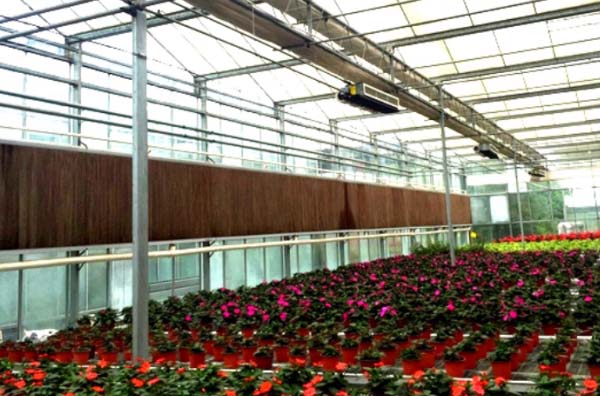
Wet curtain pads for greenhouse cooling: corrugated cellulose sheet in an aluminium frame, fitted on one wall with fans opposite.
.
TEL:+86 191 5068 3942
- Features


What the Pad Is Made Of:
The pad is a corrugated cellulose sheet, built up in layers so that the air passages run at an angle to each other and meet on the face of the sheet. That geometry is the whole point of the product: it gives a large wetted surface inside a shallow wall, and it makes the air turn as it passes through, so the air touches wet sheet rather than travelling down a straight channel. The paper is treated to take up water and hold it, which is what keeps the whole face wet between the top pipe and the trough rather than only the part directly under the water outlet.Frame, Water Channel and Fitting:
The pad does not hang on the structure on its own. It sits in an aluminium frame that holds the sheet straight along its full height, with a water channel at the bottom to catch what runs off and return it to the tank. Above the pad a distribution pipe feeds water along the top edge, and the whole assembly is fixed into the wall opening so the only way air can enter the house across that wall is through the pad. Fitting matters as much as material here - a pad that is bowed, or sitting in a frame with gaps at the ends, lets air bypass the wet face and the cooling effect drops accordingly.Choosing the Pad for Your House:
A thicker pad gives more cooling because the air is in contact with wet sheet for longer, and it also puts more resistance in the way of the fan, so the two effects have to be balanced against the fan you have. A taller pad gives more face area without a longer fan wall. The right choice is not "the thickest available" - it is the combination that delivers the cooling you need on your hottest afternoon without asking more of the fans than they can give. That calculation is done from the house volume, the fan duty and your summer temperature and humidity, which is why the pad is quoted together with the fans rather than sold by the square metre on its own.How Long a Pad Lasts:
The pad is replaced on condition, not on a fixed calendar. What ends its life is scale, algae and physical collapse of the corrugations once the sheet has dried out and been rewetted too many times. A pad fed from a covered tank, with part of the water changed regularly rather than topped up endlessly, and cleaned at the end of each season, will run for several seasons. The sign that it is finished is not that it looks old - it is that the passages are blocked so the air takes the easy way round it, and the house stops reaching the temperature it used to on the same day. When that happens, replace the sheet and keep the frame.Sizing and Ordering a Wet Curtain:
Send us the span and the length of the house, the crop you plan to grow and your summer temperature and humidity, and we will work out the pad area, the thickness and the fan duty as one set. The curtain is supplied with the rest of the greenhouse equipment we build, along with the accessories for greenhouses that go with it - the aluminium frames, the water channel and the pipework. It can be fitted to a new PC sheet greenhouse or a film house, and it is quoted together with the irrigation systems for greenhouses and the structure. Read more about our greenhouse factory, call +86 191 5068 3942 or send an E-mail to sales@cngreenhouses.com.Frequently Asked Questions:
Q: What material is the wet curtain made of?
A: A treated cellulose sheet, corrugated in layers so the air passages cross each other. That gives a large wetted surface in a shallow wall and makes the air pass across wet sheet instead of down a straight channel.
Q: How thick should the pad be?
A: A thicker pad cools more but resists the fan more. The right thickness is the one that delivers the cooling you need on your hottest day without asking more of the fans than they can give, so it is calculated from the house volume, the fan duty and your summer conditions.
Q: How often does the pad need replacing?
A: On condition, not on a calendar. Scale, algae and collapsed corrugations end its life. With a covered tank, regular partial water changes and a clean at the end of each season, a pad runs for several seasons; when the cooling drops on the same day it used to handle, the sheet is finished.
Q: Do I need to replace the frame as well?
A: No. The aluminium frame, the water channel and the distribution pipe are reused. Only the cellulose sheet is replaced, which keeps the running cost of a wet curtain low compared with systems that are replaced as a whole unit.
Q: Can one house have more than one pad wall?
A: It can, if the layout asks for it - for example on a very wide multi-span house where a single wall could not feed enough air across the crop. The air path is planned with the pad positions so the airflow stays even and no part of the house is left in still air.
Q: What information do you need to quote a curtain?
A: The span and the length of the house, the crop you plan to grow and your summer temperature and humidity. With that we can size the pad area, the thickness and the fan duty together and send a quotation for the complete set.
Note: If you're interested in the product, please submit your requirements and contacts and then we will contact you in two days. We promise that all your informations won't be leaked to anyone.
 Deutsch
 Español
 Français
 Italiano
 Português
 日本の
日本の
 한국어
한국어
 العربية
 български
 hrvatski
 česky
česky
 Dansk
Dansk
 Nederlands
 suomi
suomi
 Ελληνικά
 हिन्दी
 norsk
norsk
 Polski
 Română
 русский
 Svenska