
- Commercial Greenhouse
- Film Greenhouse
- PC Greenhouse
- Glass Greenhouse
- Tunnel Greenhouse
- Scientific Research Greenhouse
- Vegetable Greenhouse
- Flower Greenhouse
- Multi-span Greenhouse
- Sawtooth Greenhouse
- Greenhouse Equipments
- Greenhouse Accessories
- Hot Dip Galvanized Pipe
- Irrigation System
- Hydroponics System
- Planting Tools
- Planting technology
Tel: +86 191 5068 3942
Fax:
Mobile: +86 191 5068 3942
Contact: Alina
E-mail: sales@cngreenhouses.com
SKYPE:

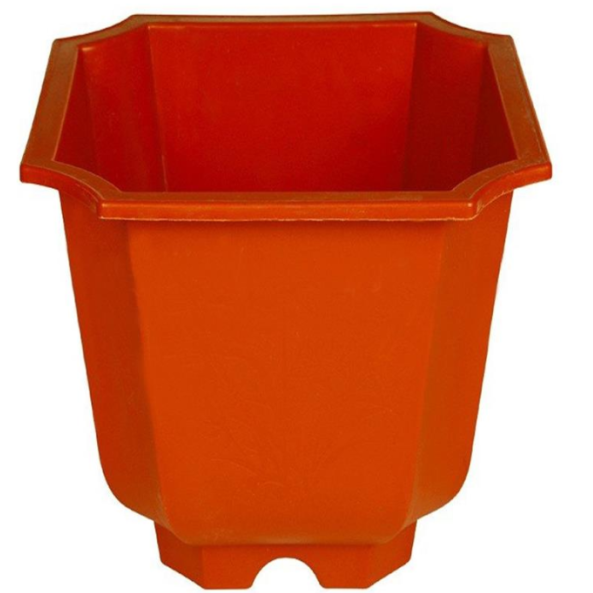

Square Seed Planter - PP Nursery Pot, BP90 to BP180
Square PP nursery seed planter for greenhouse benches, six sizes from BP90 to BP180 with carton data.
.
TEL:+86 191 5068 3942
- Features


Product Description:
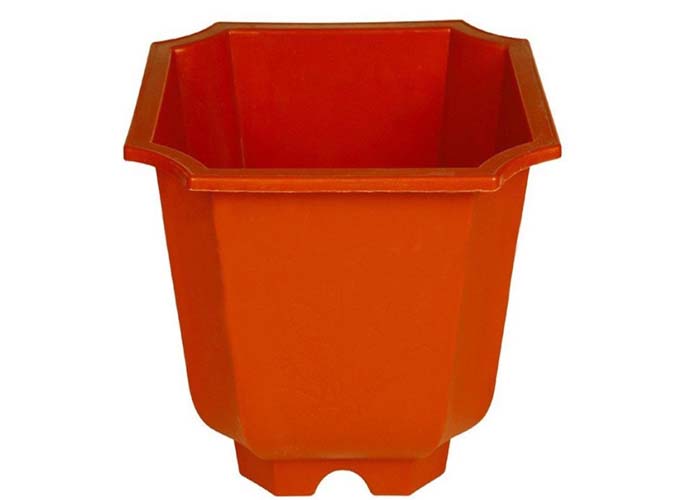
The photograph above shows one square seed planter opened up, and it is worth looking at because the working parts of the pot are all on the inside. The walls taper inwards from a wide square rim to a smaller square base, the four corners carry moulded ribs that stop the sides bowing out when the pot is filled and lifted, and the base is notched so that surplus water drains away and air reaches the bottom of the root ball. That combination is what makes a plastic pot work in a nursery: the plant is held upright, the roots are not left standing in water, and the root ball slides free at transplant without being torn. Six sizes cover the whole propagation sequence, from BP90 at the plug stage up to BP180 for a finished plant.
Specifications:
1. Material : PP material (polypropylene), moulded in one piece.
2. Colours: Red, Yellow, Green, Orange, White.
3. Usage Time : can be used for 3 years under normal usage.
4. Scientific design first quality material make it good for permeability and ventilation.
5. Total range of size — six moulds, BP90 to BP180, listed in the table below.
2. Colours: Red, Yellow, Green, Orange, White.
3. Usage Time : can be used for 3 years under normal usage.
4. Scientific design first quality material make it good for permeability and ventilation.
5. Total range of size — six moulds, BP90 to BP180, listed in the table below.
Size chart and carton packing:
|
Item No. |
Description | Carton Package Details | ||||||
|
Top Dia (mm) |
Top Dia (inch) |
Bottom Dia (mm) |
High (mm) |
PCS /CTN |
Carton Size (cm) |
G.W./CTN ( kgs ) |
CBM /CTN |
|
| BP90 | 90 | 3.5 | 60 | 80 | 3150 | 64×55×56 | 23.55 | 0.2 |
| BP100 | 100 | 4 | 70 | 90 | 1800 | 51×51×56 | 19 | 0.146 |
| BP120 | 120 | 4.7 | 85 | 105 | 1000 | 61×49×53 | 15.5 | 0.159 |
| BP130 | 130 | 5 | 88 | 115 | 900 | 53×40×55 | 15.5 | 0.117 |
| BP140 | 140 | 5.5 | 95 | 125 | 800 | 57×57×58 | 16.5 | 0.189 |
| BP150 | 150 | 5.9 | 105 | 135 | 600 | 61×46×56 | 15.5 | 0.157 |
| BP160 | 160 | 6.3 | 110 | 145 | 600 | 65×49×57 | 18 | 0.182 |
| BP180 | 180 | 7 | 130 | 150 | 450 | 55×55×58 | 18 | 0.176 |
Drainage and root management:
A nursery pot fails in two ways, and both are solved at the base. Overwatering shows up first: if water cannot leave, the bottom of the root ball stays saturated, the roots lose air and the plant stalls or rots. The notched base in the picture lets surplus water run straight out while the pot stands on a bench. The second problem is root circling inside a smooth-sided pot. A tapered wall, where the base is about two thirds of the top width, discourages roots from running round the wall, and it is the reason the root ball releases cleanly when you turn a plant out instead of clinging to the sides. The corner ribs matter as much as the base: they are what keeps the square section rigid when a pot full of wet medium is lifted by the rim. Square planters also tile without gaps, so a bench or a carrier tray that holds round pots will hold noticeably more of these. For germination work before the pots go on the bench, our plastic seeding tray is the matching tray, and the black nursery specification is covered on the black nursery pot page.
Working out a container load:
The packing columns exist so you can price a shipment before you speak to us. Take BP180: 450 pieces to a carton weighing 18 kg gross, occupying 0.176 CBM. Because the pots nest inside each other, that carton volume is roughly half what the same box would measure if the pots were stacked loose — nesting is why pot freight is cheap relative to volume. BP90 is at the other end, 3150 pieces to a carton at 23.55 kg and 0.2 CBM, which suits a propagator moving very large numbers of plugs. Work out your mix of sizes, add the carton counts and you have a container plan. If the pots are travelling with a structure, the same shipment can carry the frame — our greenhouse equipment index covers the rest of the range. The complete moulding programme, including trays, clips and nets, sits under greenhouse planting tools, and the same planter in a smaller multi-colour presentation is on the square plastic seed planter page. For background reading on nursery practice and propagation hygiene, the NGMA publishes industry guidance for protected cropping, and HortWeek reports on how growers and nurseries run production.
Frequently Asked Questions:
Q: What sizes does the square seed planter come in?
Six items, BP90 to BP180, given as top diameter, bottom diameter and height in millimetres: BP90 is 90/60/80, BP100 is 100/70/90, BP120 is 120/85/105, BP130 is 130/88/115, BP140 is 140/95/125, BP150 is 150/105/135, BP160 is 160/110/145 and BP180 is 180/130/150. The same table gives the top diameter in inches.
Q: How does the base drain, and does it stop roots circling?
The base is notched with cut-outs, so surplus water leaves the pot while it is standing on a bench or tray. The walls taper from a wide rim down to a base roughly two thirds of the top width, which discourages roots from running round the inside wall and lets the root ball slide out at transplant.
Q: What is the planter made of and how long will it last?
It is moulded in PP (polypropylene) and can be used for 3 years under normal usage. PP is light, does not soak up water and flexes rather than cracking when a pot is squeezed, and moulded corner ribs keep the square section rigid when the pot is lifted full.
Q: Is this pot meant for the nursery or for retail display?
Both, in different finishes. The plain colours — red, yellow, green, orange and white — are the working nursery specification for benches and carrier trays. If the plant is going to a retail shelf, tell us and we will quote the decorative double-colour version of the same range instead.
Q: How do I calculate how many planters fit in a container?
Use the PCS/CTN and CBM/CTN columns in the table above. For example BP180 packs 450 pieces per carton at 0.176 CBM and BP90 packs 3150 pieces at 0.2 CBM. Divide your container volume by the CBM per carton to get the carton count, then multiply by the pieces per carton. Because the pots nest, the figures already account for the saving.
Q: What is your minimum order for these planters?
Every order is produced to your specification and the minimum order quantity is 1 set. Mixed sizes and mixed colours in one container are normal, so send us the item numbers with the quantities and the colour split. We accept T/T and L/C, and production normally takes about 1 month after the deposit is received.
Six items, BP90 to BP180, given as top diameter, bottom diameter and height in millimetres: BP90 is 90/60/80, BP100 is 100/70/90, BP120 is 120/85/105, BP130 is 130/88/115, BP140 is 140/95/125, BP150 is 150/105/135, BP160 is 160/110/145 and BP180 is 180/130/150. The same table gives the top diameter in inches.
Q: How does the base drain, and does it stop roots circling?
The base is notched with cut-outs, so surplus water leaves the pot while it is standing on a bench or tray. The walls taper from a wide rim down to a base roughly two thirds of the top width, which discourages roots from running round the inside wall and lets the root ball slide out at transplant.
Q: What is the planter made of and how long will it last?
It is moulded in PP (polypropylene) and can be used for 3 years under normal usage. PP is light, does not soak up water and flexes rather than cracking when a pot is squeezed, and moulded corner ribs keep the square section rigid when the pot is lifted full.
Q: Is this pot meant for the nursery or for retail display?
Both, in different finishes. The plain colours — red, yellow, green, orange and white — are the working nursery specification for benches and carrier trays. If the plant is going to a retail shelf, tell us and we will quote the decorative double-colour version of the same range instead.
Q: How do I calculate how many planters fit in a container?
Use the PCS/CTN and CBM/CTN columns in the table above. For example BP180 packs 450 pieces per carton at 0.176 CBM and BP90 packs 3150 pieces at 0.2 CBM. Divide your container volume by the CBM per carton to get the carton count, then multiply by the pieces per carton. Because the pots nest, the figures already account for the saving.
Q: What is your minimum order for these planters?
Every order is produced to your specification and the minimum order quantity is 1 set. Mixed sizes and mixed colours in one container are normal, so send us the item numbers with the quantities and the colour split. We accept T/T and L/C, and production normally takes about 1 month after the deposit is received.
If you need to ask a question and get some help to find the best greenhouse for you, then just call us on +86 191 5068 3942 or send E-mail to sales@cngreenhouses.com
Note: If you're interested in the product, please submit your requirements and contacts and then we will contact you in two days. We promise that all your informations won't be leaked to anyone.
 Deutsch
 Español
 Français
 Italiano
 Português
 日本の
日本の
 한국어
한국어
 العربية
 български
 hrvatski
 česky
česky
 Dansk
Dansk
 Nederlands
 suomi
suomi
 Ελληνικά
 हिन्दी
 norsk
norsk
 Polski
 Română
 русский
 Svenska